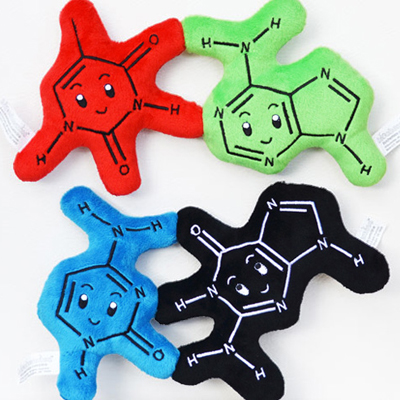
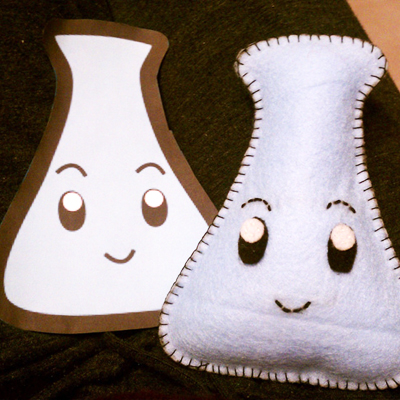
This Newtonmas (Dec. 25th), I received The Great Scientists Finger Puppets and then proceeded on a drive up the coast of CA Highway 1 (north of San Luis Obispo). I ended up documenting the adventure in a series of photos on Instagram/Twitter.
I have a bad habit of not drinking enough water. Of course hardly anyone makes the “8 cups a day” recommendation, but I sometimes go a whole day without any water at all (other than in my food)!
I first became concerned about this via Fitbit‘s water tracker. For a few days, I used this to encourage myself to drink more water, but soon returned to my old habits. Two weeks ago, I gave a Quantified Self SD talk about the Fitbit, which caused me to readdress my water intake concerns.

Alas, I found the solution! I simply switched the cup on the left for the cup on the right:

Larger cup, more water
Well, of course… but this decreases the annoyance of going to the break room to fill up more water while I’m busy working. I usually stop drinking when I finish the drink. The bigger cup encourages me to drink more.
Straw minimizes distraction
While a straw seems childish or too much like fast-food drinks, it’s actually much better for productivity. Drinking a mug requires more attention than drinking out of a straw. Multi-tasking becomes easier and hence it becomes natural.
I’m half way though my second large cup today. Hope this new habit sticks around.
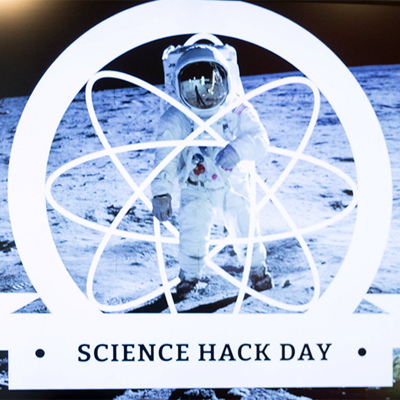
Two weekends ago, I flew up to Palo Alto to attend Science Hack Day. It was a two-day event held at the Institute for the Future. Apparently, the concept of Science Hack Day first sprung during a panel on open science at this past SxSW, which funny enough, I attended! The first Science Hack Day was done in London, England in June 2010.
There are going to be official write-ups of the event by the organizers, so I don’t want to be redundant and rather talk about the project I participated in and what I got out of the Hack Day.
I worked with Dawei Lin on making a LED display for DNA sequences. The 4 nucleic acid bases would be represented by 4 different colors: red, green, blue, and purple (made from red and blue). The lights were programmed by Arduino to blink and move. We would be able to pass through any DNA sequence and embed it into a decorative piece to draw awareness to the concept of “wearing what you are”. Dawei had fiddled with the idea for 2 hours previously and brought some materials. While the project is simple to any electric engineer, us two biologist had much to learn. Luckily, many people at Science Hack Day were experienced with circuits and Arduino, so we had lots of help along the way. We started with this:
… and spent the rest of Saturday building it up to this:
The next step was originally to embed it into a DNA hat that Dawei’s wife made, but that would have been impossible with the materials and amount of wires our circuit required. So, the easier idea was to make a tie. Instead of using an actual tie, we ended up making a duct tape tie from watching a YouTube video made by an 8-year-old. It was great!
We attempted to make smaller circuits that we could place right behind the tie like this:
Unfortunately we did not have enough time to finish them and we were unable to make all the lights we wanted to (which was 48). We ended up with just 8 lights. (The print material around it was to hide the breadboard and all the wires.)
What was the sequence on the DNA tie, you may ask? It was a 24-base long sequence that when translated spelled out S-C-I-H-A-C-K-D. Here was our infograph:
What I got out of Science Hack Day
1) I met a lot of awesome people doing awesome things! :)
2) I’ve never done anything electrical before, but after this experience, I feel confident building my own circuit on a breadboard (not sure about the soldering part yet).
3) This was also my first experience with Arduino after hearing people rave about it for years. It is indeed very simple, cheap, yet powerful. The community around it seems great too.
4) I’ve decided, for an upcoming project, to use Arduino to power some kind of LED accessory for my wedding dress.
5) Finally, I love the concept of Hack Days. It draws together all kinds of talent to collectively put together projects that people have been thinking about but never had the time to do. Conference after conference, they are all about talking and spreading ideas, but here we finally implement those ideas and build something to share with the world. Even the seemingly small projects are contributions toward innovation, education, and the future. I want to be a part of this synergy… and might be bring it to San Diego! (*hint hint*)
More Coverage of Science Hack Day
BBC radio segment by @RadioKate! (20:55 minutes in)
Hack me with science: a look back at Science Hack Day SF
We have lift-off! Science Hack Day SF 2010 by @arielwaldman
Pictures: mine, Flickr group